Modernity and Vision/Reading Pictures
In our first class the concepts of the visual and visuality were introduced through Hal Foster’s article “Vision and Visuality” and James Heffernan’s article “Literarcy and Picturacy”.
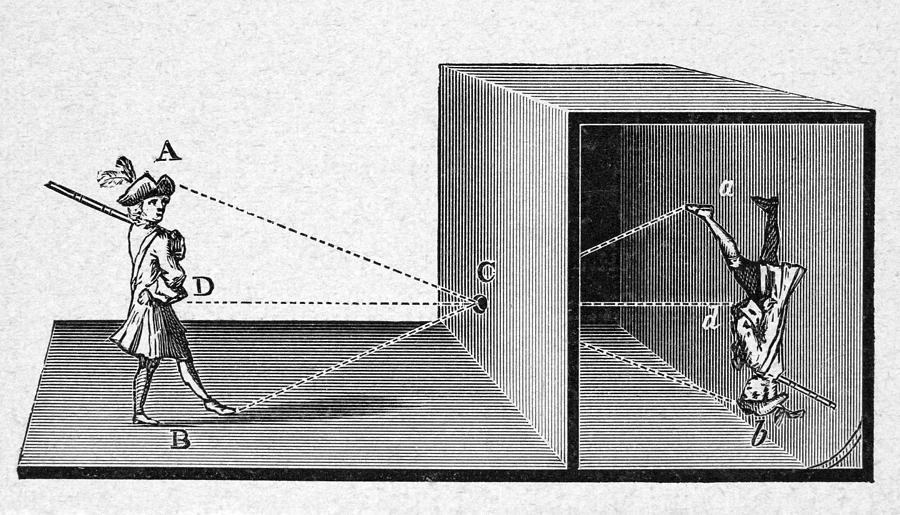
Foster’s article discusses the camera obscura, which is essentially a room set up with a pin hole camera. We explored what this method meant as a socially constructed artifact. The camera obscura attempted to capture a scene in its most natural state to produce a logical and “real” image. The belief was that this method allowed us to draw truthful inferences on the external world, which seems to indicate that there is only a single objective way of seeing. This idealist belief ignores the fact that image is temporal, and that the body is capable of misperceiving. We discussed how in reality vision is subjective and we may interpret the same scene differently. The discovery of the afterimage mentioned later on in the article revealed that sight is capable of failing.
Heffernan’s article discussed how we do not learn to read pictures and he invents the term “picturacy”, which parallels the term “literacy” . To learn to read images, we have to forget how we have been conditioned to think of them since birth.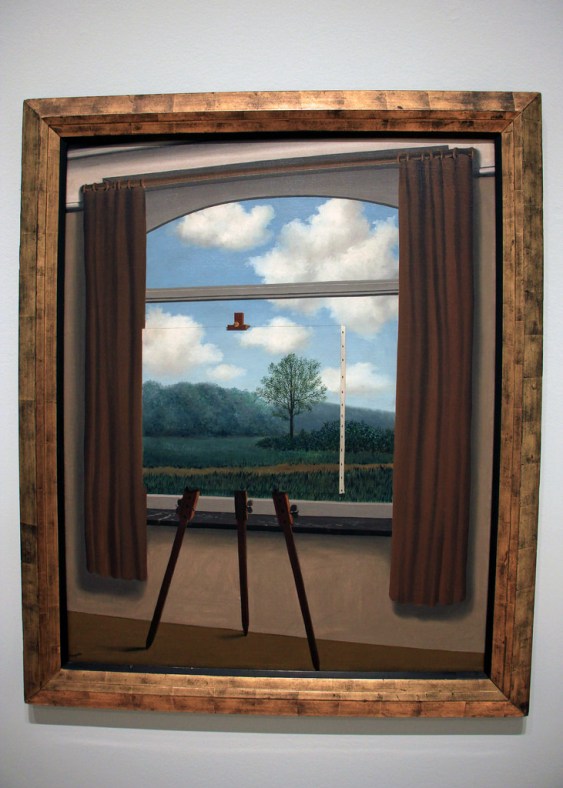
We looked at several images, such as la Condition Humaine by Magritte displayed above, and provided our own interpretations on what we think the image is trying to say about the human condition. Our different interpretations reinforced the point from Foster’s article that image is subjective and we will not always see the same thing. The canvas reveals exactly the scene behind it, which is merely a view of outside the window. I interpreted this as meaning that the human condition is that we lack imagination by only seeing what is in front of us, when the canvas could have been covered in something nonconventional.
 Modernity & The Visual: Image & Text