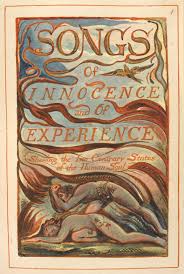
Word and Image in William Blake
In Heffernan’s article “Text and Design: Blake’s Songs of Innocence and Experience”, he notes that there is a certain inconsistency in Blake’s collection of poems since his illustrations are not always representative of the text. This inconsistency is Blake’s way of rejecting the 18th century view on aesthetics that painting and poetry are meant to coalesce rather than contradict. This concept opposes the intent of the camera obscura, which is to capture an accurate representation.
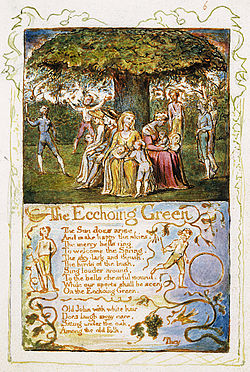
Heffernan notes that Blake will sometimes mention artifacts or objects that are seemingly significant but they perhaps are not intended to be visualized. For example, in his poem in the Echoing Green pictured above, the poem makes reference to an old man and old folk. This visual is not clearly reflected in Blake’s illustrations, since the illustrations contain younger families.
We discussed how the positioning of the text was also significant. In the Echoing Green, for example, the text appears to be clearly separated from the illustrations by a barrier of vines. This could signify the unattainability of permanent youth by creating a boundary between the young characters and the text.
I also noticed how Blake selectively highlights certain lines of text in yellow. It appears to be fitting for certain lines to symbolize their meaning, such as “the sun does descend”. But for other phrases illustrating darkness (“on the darkening green”), which seems to contradict the text, demonstrating Blake’s aim to challenge the manner in which we relate the text to the image.
 Modernity & The Visual: Image & Text