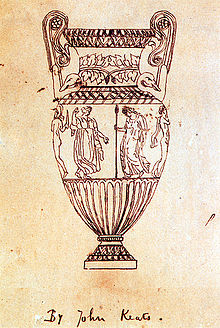
This week’s topic was ekphrasis. Ekphrastic work provides a vivid description of a visual work of art. Sam’s presentation focused on the poem by Keat’s “Ode on a Grecian Urn” in light of concepts explored in Heffernan’s and Mitchell’s articles.
Sam took the standpoint of ekphrastic indifference, meaning that ekphrasis is impossible. Mitchell remarks that art history is an elevated form of ekphrasis, which by the indifference standpoint essentially diminishes the value of art history as a discipline overall.
Sam rejects Mitchell’s extension of the relationship of image and text to a social context, particularly of race. Sam raises the issue of having pre knowledge of hierarchy, and of assuming that the poet and the reader are white.
In class, we noted that description is not necessarily a representation. Ekphrastic poetry aims to immortalize visual art, since in its time art was considered perishable. As early 19th century artifacts traveled around the world, their condition was jeopardized and ekphrasis was a way of preserving their auras.
We discussed Coleridge’s points on ekphrastic. He states that good writing makes you see without any conscious effort. The power of the word is more flexible, enduring and more suited for the mind instead of poetry. Coleridge was a poet and may be biased in this regard.
If we are ever completely successful in recreating the image, we undermine the text/image relation.
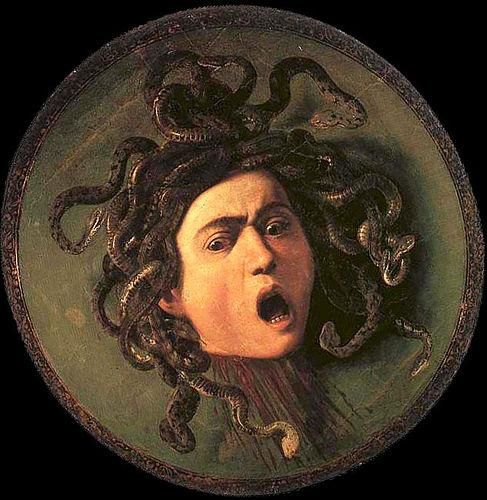
In his article “On the Medusa of Leonardo Da Vinci in the Florentine Gallery”, Heffernan challenges the common interpretation that the spectator gazing becomes petrified and presents the idea that the head may be gazing inward on her own spirit.
 Modernity & The Visual: Image & Text