Modernist Ekphrasis: Poems and Paintings in Auden and
Williams
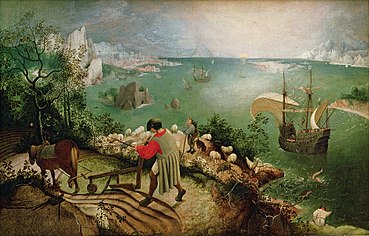
This week we covered modern ekphrasis. Alex presented first on the Fall of Icarus, comparing Auden’s poem and Williams’ poem on their ekphrastic interpretation of the Landscape of Icarus. Peyton focused on poems in Pictures from Brueghel by William Carlos Williams.
Other depictions of the Fall of Icarus, such as the one in the Louvre, depict Icarus as the focal point in the sky. In the painting the Landscape of Icarus, once he falls down to earth he goes unnoticed – no one cares about his death in midst of life. The revision of the title from Fall of Icarus to the Landscape of Fall of Icarus subordinates Icarus in the painting to all that surrounds him.
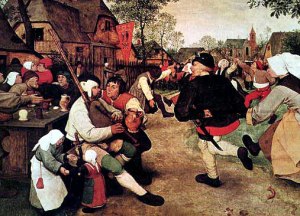
Pieter Brueghel, Kermesse
We also looked at “The Dance” by William Carlos William on the painting Kermess (above). The image presents sturdy, well-fed peasants. The title of the painting means both a holiday (festival) and a holy day (originally a celebration of a local saint’s anniversary). The painting however shows the peasants celebrating in ways that are not so holy, by celebrating in lustful and gluttonous ways. The peasants are shown enjoying themselves, but after it’s over they will return to their struggling lives. The image shows that art does not need to represent a romanticized scene; it can also represent something from everyday life.
 Modernity & The Visual: Image & Text