Writing About Photographs
Today we discussed Barthes’ Camera Lucida. The big question that arose in class was whether a photo can achieve transparency.
Stephen discussed Barthes’ motivations for writing on photography. He notes some of Barthes’ former works, such as Mythologies and A Lover’s Discourse, and he questions how they connect with the topic of photography. He comes to the conclusion that the theme of searching for meaning unites them all and that Barthes is particularly interested in the emotional impact of photography.
Unlike paintings, photographs replicate existentially what can no longer be repeated. In this manner, a photograph can be described in relation to death. A photograph is a witness of something that is no more.
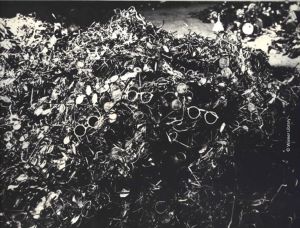
Lena’s presentation focused on war photography. The images shown, such as the one displayed above of a pile of glasses from Aushwitz, evokes a feeling of disturbance. In the two presentations, the concepts of studium and punctum were discussed. The photo above falls under the category of studium, because it makes you curious.
When an individual is shown in a photo, however, this evokes a stronger sense of empathy because we recognize them as an individual being. The “identifiable victim effect” is the tendency to offer greater aid when a specific person is observed under hardship, which is why we see those advertisements asking for charity for a single child living in poverty rather than a larger group. These adverts are more punctum, since they intend to pierce the viewers.
 Modernity & The Visual: Image & Text